
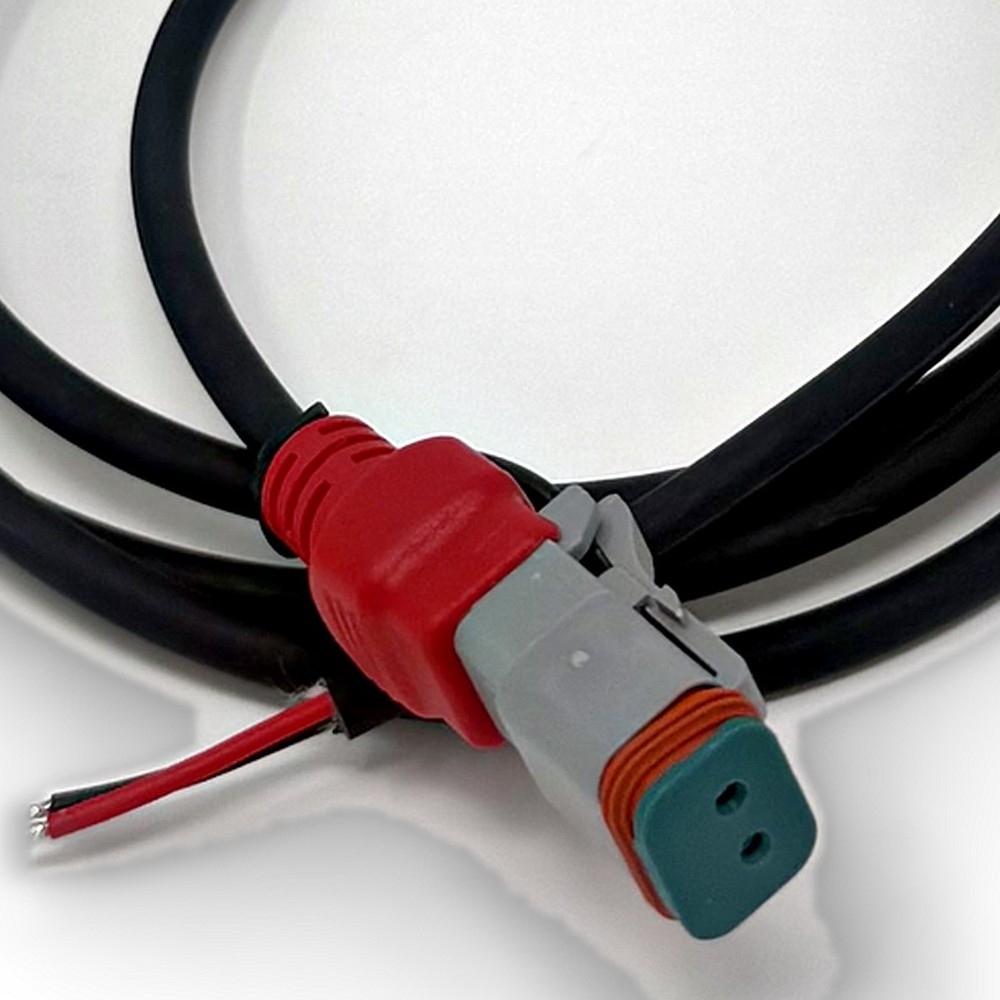
Short answer DT-style connectors (compatible with Deutsch DT) come in 2, 3, 4, 6, 8 and 12 positions and use size 16 contacts for 14–20 AWG wire. The receptacle holds pins and the plug holds sockets. Each half is locked with a wedgelock, and every unused cavity needs a cavity plug. This guide covers the parts, the part-number logic and the mistakes that cause field failures.
The basics
- Positions: 2, 3, 4, 6, 8 and 12.
- Contacts: size 16, for wire from 14 to 20 AWG. Current capacity depends on the contact and wire size; up to 13 A on the largest wire.
- Temperature: rated for roughly −55 °C to +125 °C.
- Assembly: crimp-only. Soldered contacts crack and fail.
- Intermateable families: Amphenol AT-series connectors are built to mate with DT-series parts. FormRep’s DT-compatible cable assemblies use Amphenol AT connectors.
Plug vs. receptacle: the part that confuses everyone
The names go by housing, not by contact:
- Receptacle (DT04 style): holds pin (male) contacts. This is the half you often see molded onto modules, sensors and valve banks.
- Plug (DT06 style): holds socket (female) contacts. This is usually the harness side that plugs in.
So a “4-pin female” DT-style cable end is a plug with four sockets, and it mates with a 4-pin receptacle.
Wedgelocks
A wedgelock snaps into the face of the housing and locks the contacts in place. Receptacles take a pin-side wedgelock and plugs take a socket-side wedgelock, sized to the position count. A connector without its wedgelock fully seated can back a contact out under vibration, and that is one of the most common causes of intermittent faults.
Keying
When several connectors of the same size sit side by side, keying stops the wrong two from mating. Keyed versions are usually labeled A, B, C and D. On 8- and 12-position housings the key is part of the housing and is often color-coded. On smaller sizes, keyed wedgelocks are used. If two harness branches can reach the same port, key them differently.
Sealing: cavities and whole ports
- Unused cavity: an empty hole in a connector that is otherwise in use. Fill it with a cavity sealing plug, or that connector loses its seal.
- Unused port: a whole receptacle with nothing plugged in. Cap it with a mating plug. A one-piece sealing plug like the Socket Lock™ replaces the housing, wedgelock and cavity plugs with one part. More in How to seal unused DT connector ports.
- Wire seals: the rear grommet seals around each wire only if the wire’s insulation diameter is in its range. Very thin insulation on 20 AWG wire is a classic leak point.
The DT family: DTM and DTP
- DTM-style: smaller housings with size 20 contacts for lighter wire and lower current, typically sensor and signal circuits.
- DT-style: the general-purpose middle of the family, covered above.
- DTP-style: larger housings with size 12 contacts for heavier wire and higher current, like power feeds.
The families look alike but do not intermate. Pick by wire size and current first.
Mistakes that cause field failures
- Soldering instead of crimping, or using the wrong crimp tool.
- Wedgelock not fully seated.
- Empty cavities left unplugged.
- Wire insulation too thin for the rear seal.
- Unused ports left open to weather.
- Field splices next to a sealed connector, which moves the weak point a few inches down the cable.
Need it built instead of building it?
FormRep builds DT-, DTM- and DTP-style harnesses and cable assemblies, overmolded and 100% tested, including adapters to M12 and DIN valve connectors. Shop the ready-to-ship parts, check the part cross-reference, or send a drawing or sample for a quote.
Deutsch is a trademark of its owner, used here for identification only.