
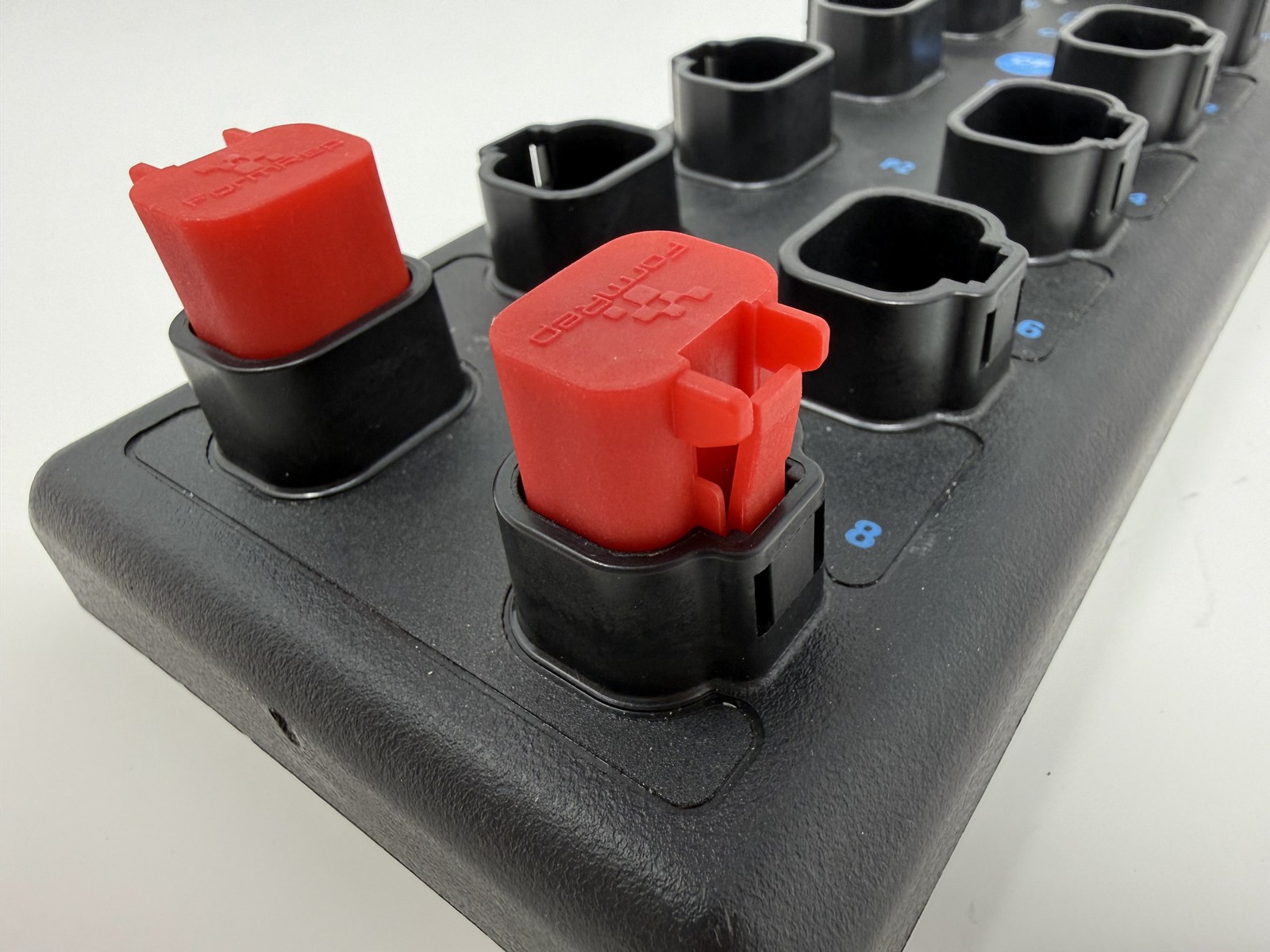
Short answer an unused DT-style port should never be left open. Tape and caps are stopgaps. The reliable fix is a plug that latches into the port and seals it the same way a mating connector would, either a built-up dummy connector or a one-piece sealing plug like the Socket Lock™.
Why an open DT port is a problem
DT-style connectors are built to be sealed as a pair. The seal only works when a mating connector is latched in. An I/O module, a valve bank or a harness branch with an empty port has lost that seal, and on mobile and outdoor equipment that port is sitting in rain, wash-down spray, road salt and dust.
What gets in does damage slowly:
- Corroded pins. Moisture sitting on exposed pins turns into green corrosion. A port you plan to use next season may not make good contact when you need it.
- Shorts and phantom faults. Water and conductive dust across live pins can cause intermittent faults that are hard to trace back to an “unused” port.
- Debris in the cavity. Packed-in dirt keeps a connector from seating fully later, which defeats its seal even after you plug something in.
The common fixes, and what each one really does
Electrical tape or heat shrink
Quick, and better than nothing for a day. Tape loosens with heat and vibration, and once an edge lifts it holds moisture against the pins instead of keeping it out. Heat shrink has to be cut off to use the port.
Dust caps
Caps keep dirt and direct spray off the face of the port. Check whether the cap you’re using is designed to seal against the connector’s own seal or just cover it. A loose cap can trap condensation.
A built-up dummy connector
The traditional “proper” fix: a mating plug housing, its wedgelock, and a cavity sealing plug in every hole, assembled and latched into the port. It seals because it is a real connector. The catch is the part count. A 4-pin port takes a housing, a wedgelock and four cavity plugs, so there are six small parts to stock, assemble and get right on every port.
A one-piece sealing plug
A one-piece plug does the same job as the built-up dummy connector in a single molded part. The patent-pending Socket Lock™ has an integrated DT-style latch and a silicone seal. You push it into the port by hand until it latches, with no tools and no loose parts. To use the port later, press the latch and pull it out.
Picking the right plug
- Match the pin count. A 4-pin port takes a 4-pin plug. Socket Lock comes in 4-pin and 6-pin versions that mate with DT-style receptacles (DT04-4P and DT04-6P compatible).
- Check whether the port needs termination. On CAN and similar bus networks, the open end of the bus may need a 120 Ω terminating resistor. The Socket Lock 120 Ω terminating plug seals the port and terminates the bus in one part.
- Think about visibility. A bright red plug makes it obvious during a walk-around which ports are capped on purpose and which are missing a connector.
Unused ports vs. unused cavities
These are two different problems. An unused port is a whole connector with nothing plugged in, and that is what Socket Lock seals. An unused cavity is one empty hole inside a connector that is otherwise in use, such as a 6-pin plug wired with only four circuits. Every empty cavity in a used connector still needs its own cavity plug, or that connector loses its seal too.
Common questions
Can I leave a port open if it’s on the inside of the machine?
“Inside” on mobile equipment usually still sees condensation, wash-down and dust. If the port is not in a sealed enclosure, plug it.
Will a sealing plug work on a cable-assembly socket as well as a module?
Yes, as long as the pin count and style match. Socket Lock works on I/O module ports and on DT-style receptacles in cable assemblies.
What if I need a different pin count, color or resistor value?
FormRep builds made-to-fit versions. Request a quote and tell us what the port needs.