
Short answer a short injection molding run does not need a big order. At FormRep, about an hour north of Kansas City in Saint Joseph, Missouri, there is no minimum run. A typical project goes from a 3D-printed prototype to a tool you own, then production parts, with tooling usually taking 4–12 weeks depending on the part.
What “short run” means here
A short run is any quantity too small to interest a high-volume molder: a few hundred replacement parts, a first batch for a product launch, or a few thousand housings a year. Many molders want large orders to justify setting up a press. We mold in our own shop and have hundreds of customer tools in our library, so running a smaller order is normal work for us.
How a project runs, step by step
1. Start with the part or the problem
Bring a drawing, a CAD file, a sample part, or just a description of what it needs to do. A sample is often enough. We’ve rebuilt parts with no drawings at all (see the Pendant Enclosure story).
2. Design review
Before any steel is cut, we check the design so it will mold cleanly: wall thickness, draft, gate location and features that would make the tool more complicated than it needs to be. Changes are cheap at this stage and expensive after the tool is built.
3. Prove it with a printed prototype
For a new design, a 3D-printed prototype lets you check form, fit and function in your own equipment. Changing a print costs a reprint; changing a mold costs rework.
4. Tooling
We build tools in the U.S. or overseas, chosen by cost, timeline, volume and quality. Tooling typically takes 4–12 weeks depending on complexity. You own the tool; it is built for your part.
5. First samples and production
First-shot samples are checked against the approved design. Then production runs, with inspection before parts ship.
6. Stocking
If you reorder regularly, ask about our stocking programs, so parts are on the shelf instead of on a schedule.
Why a nearby molder helps
- You can bring the part in. Holding the sample and talking through it is faster than a dozen emails.
- Prototypes and first articles come back fast, so decisions don’t wait on freight.
- One team from design to delivery. Design, prototyping, tooling, molding and inspection are managed in one place.
A Missouri example
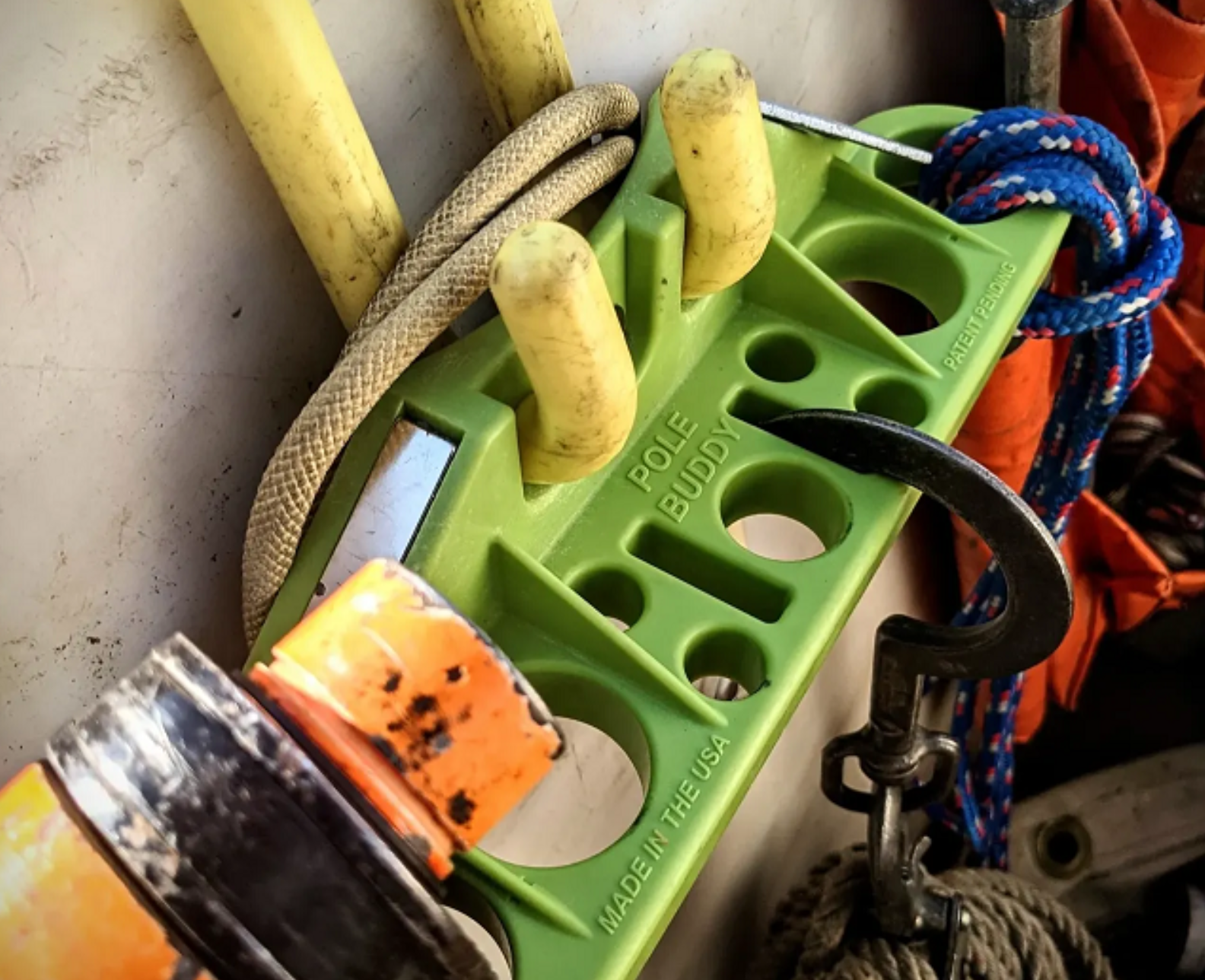
Pole Buddy, a tool holder for linemen, started as a sketch. We modeled it, printed prototypes for field testing, and had the injection mold made in about six weeks. It launched in 2022 at the International Lineman’s Rodeo in Overland Park, made in Missouri.
Injection molding or rotomolding?
For large hollow parts like tanks, bodies and housings, rotational molding is often a better fit, with lower tooling cost. We’ll recommend the right process for the part.
Common questions
Is there a minimum run?
No. Buy the tool and run one part, or run thousands.
Who owns the mold?
You do.
What does tooling cost?
It depends on part size, complexity and volume. Send the part or the drawing and we’ll quote it.
What materials can you mold?
Most common plastics and many specialty resins. Tell us what the part needs to do, and we’ll help choose.