
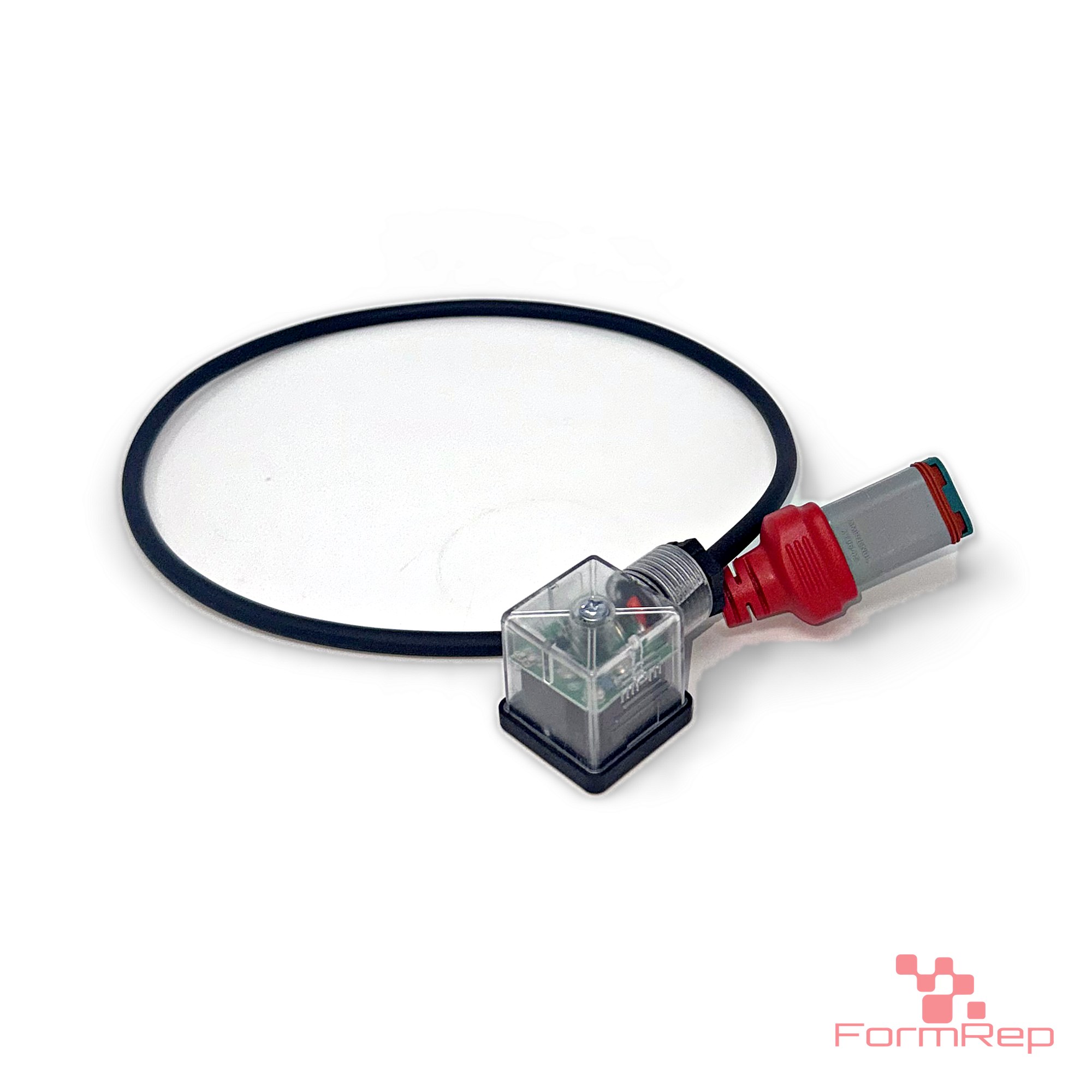
Short answer a DIN solenoid valve and a DT-style harness have two different connectors, a DIN valve connector on the valve and a DT-style connector on the harness. Instead of having a technician wire one to the other in the field, use a single overmolded cable with the DIN connector on one end and the DT-style connector on the other. If you want status and coil protection, pick one with an LED and suppression built in.
Two connectors that were never meant to meet
Hydraulic and pneumatic solenoid valves usually come with a DIN valve connector: a square plug that screws onto the coil. Mobile equipment harnesses are usually DT-style. So the valve has one kind of connector and the harness has another.
The usual workaround is a DIN connector with screw terminals, wired in the field to a DT-style pigtail and sealed up as well as the tech can manage. It works, but every one is built by hand, in the field, to whatever standard that day allows. Loose terminals, a gland that wasn’t tightened, or two wires swapped become intermittent valve problems later.
The one-part answer
An overmolded DIN-to-DT cable puts both connectors on one cable, molded and tested before it ships. Nothing gets wired at the machine: the DIN end goes on the valve, the DT end plugs into the harness, and the job is done. FormRep tests every cable assembly 100% for opens and shorts, insulation resistance, contact resistance and hi-pot.
Know your DIN valve connector
DIN valve connectors are defined by EN 175301-803 (formerly DIN 43650). They come in three sizes, called forms, and the form has to match the coil:
- Form A: the largest and most common, with 18 mm contact spacing. Usually two contacts plus earth (2+PE).
- Form B: a smaller “micro” size, typically 10 or 11 mm spacing.
- Form C: the smallest, 8 or 9.4 mm spacing, for compact valves.
Measuring the spacing between the coil’s contacts, or checking the valve’s data sheet, will tell you the form.
LED and suppression: worth having
- LED status indicator. A light in the connector shows when the coil is being energized, so a technician can tell at a glance whether the valve is getting a signal. That cuts troubleshooting time.
- Suppression. When a coil switches off it kicks back a voltage spike. A suppression circuit in the connector absorbs that spike before it reaches the controller output or the rest of the harness.
Match the LED and suppression rating to your system voltage. FormRep’s ready-to-ship cable is rated 24 V DC/AC.
What to match when you choose a DIN-to-DT cable
- DIN form (A, B or C) and contact arrangement (2+PE or 3+PE)
- System voltage, and whether you want an LED and suppression
- DT-style pin count and pinout on the harness side
- Cable length and jacket (PUR stands up to oil and abrasion)
Ready-to-ship DIN-to-DT cable
DT-compatible 4-pin female to DIN valve Form A, LED + suppression, 0.6 m. It has an Amphenol AT-series DT-compatible socket on one end and a Form A valve connector (2+PE) with LED and suppression on the other, rated 24 V DC/AC, on 18 AWG PUR cable.
Need a different form, length, voltage or pinout? FormRep builds made-to-fit versions. See Cable Assemblies & Electronics or request a quote.
Common questions
Will a Form A connector fit a Form B coil?
No. The forms have different contact spacing and won’t mate.
Do I need suppression if my controller already has it?
Some controller outputs include protection, many don’t. Suppression at the coil is cheap insurance and protects the harness too. Check your controller’s documentation.
Can you match the cable to a valve and harness we already use?
Yes. Send the valve and harness part numbers, or a sample, and we’ll build to it.